Fuel Surcharge
A surcharge isn't proof that a load pays. Connect the agreed fuel adjustment to eligible miles, actual fuel costs, driver pay, and the margin left after delivery.
By TruckTA Editorial Team · TruckTA Resources

In this article
Last updated: November 2026
Your broker offers a fuel surcharge, but the truck still has deadhead before pickup and an uncertain reload after delivery. Treat that charge as a negotiated fuel-related adjustment, not proof of profit. Check what the agreement pays, then compare total trip revenue with the costs of doing the work.
Start with your booked rate and keep the fuel adjustment visible through closeout. For the broader acceptance decision, pair this process with How to Use a Car Hauling Trip Profitability Worksheet Before Accepting a Load. Here, the job is narrower: calculate the agreed adjustment and find out what it actually recovered.
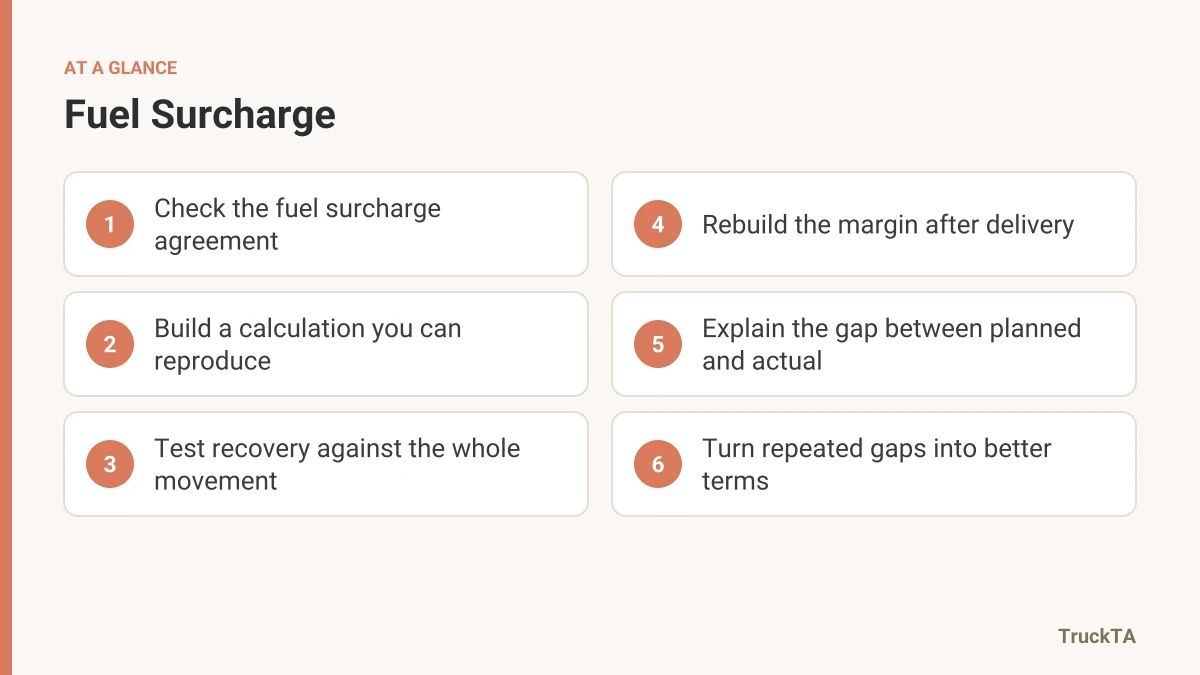
Check the fuel surcharge agreement
Separate the price reference from the payment agreement
The U.S. Energy Information Administration says fuel surcharges are negotiated privately by shippers and transportation companies (opens in a new tab). EIA also states that it does not calculate, assess, or regulate them. However, don't mistake a reference to an EIA price for a complete payment agreement.
Ask the broker or customer to identify the calculation method before you commit. Get the applicable price reference, effective period, covered mileage, and adjustment terms in writing. Otherwise, dispatch and billing may calculate different amounts from the same load confirmation.
For example, a confirmation might quote an all-in payment rather than separate linehaul and fuel amounts. Record that total as the offered revenue. Don't add another adjustment unless the agreement supports it, and don't assume a broker's customer-facing charge becomes your carrier payment.
Resolve the details that change the result
Before booking, clarify which event selects the applicable pricing period: acceptance, pickup, delivery, or another agreed trigger. Also specify how to handle a rescheduled pickup. Keep that trigger consistent instead of choosing whichever published price produces the larger invoice.
Next, identify what earns the adjustment. Is it attached to the truck movement, each vehicle, eligible miles, or a percentage of specified charges? For a mixed trailer, connect each customer's terms to that customer's booked vehicles rather than applying the richest agreement across the load.
Build a calculation you can reproduce
Use explicit inputs instead of a remembered rate
EIA collects and publishes weekly retail diesel fuel price data (opens in a new tab). If your agreement uses that information, save the applicable observation and its date with the calculation. Check the current publication before applying the agreement; don't copy a price from an old dispatch note.
For a proposed mileage-based agreement, you could use the calculation below. Treat it as a method to negotiate, not a universal formula. Your fuel surcharge calculation must follow the accepted agreement, including any table, rounding convention, floor, or cap.
Proposed adjustment per eligible mile = (selected diesel price − agreed base diesel price) ÷ agreed fuel economy. Then multiply that result by eligible miles. Specify how the method handles a selected price below the base before using it.
In this proposed method, the base price represents the fuel-price allowance built into linehaul. The fuel-economy input converts the price difference into a mileage adjustment. However, use the agreed input for billing, even when your truck's observed fuel economy differs.
Keep alternative methods separate
If your agreement instead specifies a percentage, multiply that percentage by the charges it names. Don't apply it to detention or other accessorials without supporting terms. Likewise, use the stated lookup table when the agreement calls for a table rather than a formula.
Finally, keep enough detail for another dispatcher to reproduce the result without calling you. Preserve the input price, pricing period, calculation basis, eligible quantity, and agreed rounding. A final amount without those inputs leaves billing to reverse-engineer the booking.
Test recovery against the whole movement

Separate eligible miles from miles you operate
Build the operating route from the truck's actual starting position through pickup and delivery. Include the repositioning you assign to that movement. Meanwhile, keep surcharge-eligible miles in a separate field; don't substitute them for the distance your equipment must travel.
Consider a planning scenario: the trailer delivers near an auction, but the next booked pickup sits farther away. Your agreement covers the loaded movement only. In that case, keep the approach deadhead in the cost estimate even though it doesn't earn the adjustment.
For a proposed add-on vehicle, compare the route with and without that pickup. Include the extra approach, delivery deviation, and expected waiting time. Then check the added revenue against the added cost rather than crediting the vehicle with revenue already earned by other units.
Keep the benchmark out of your expense estimate
EIA's methodology describes collecting cash self-serve pump prices, including taxes, from sampled retail diesel outlets (opens in a new tab). Use the agreed benchmark for billing. Separately, estimate your operating expense from the fuel prices and consumption assumptions appropriate to the assigned truck.
Next, estimate trip gallons from operating miles and a defensible equipment-specific consumption assumption. Make any waiting or auxiliary-use allowance explicit rather than hiding it in mileage. Don't give a wedge and a larger transporter the same assumption merely because they share a destination.
To test fuel surcharge recovery, compare the adjustment with the incremental fuel expense above your planned base allowance. Don't compare it with the entire fuel bill. Keep that recovery test separate from the full-margin test, which includes all fuel expense.
Rebuild the margin after delivery

Replace assumptions with supported trip amounts
At closeout, begin with the agreed revenue and document any approved changes. Replace estimated miles, tolls, and pay with supported amounts. However, leave unresolved charges visible as exceptions instead of treating an unanswered detention request as confirmed revenue.
For fuel, distinguish purchases from consumption assigned to the movement. A fill before pickup may leave fuel available after delivery. Use a consistent allocation method, preserve its basis, and label the fuel cost estimated whenever you lack enough information to establish consumption.
Then use the following management calculation to rebuild your result. Keep the cost categories consistent between quoted and completed trips. Otherwise, an apparent improvement may reflect omitted costs rather than better work.
| Calculation stage | Include | Keep separate |
|---|---|---|
| Confirmed trip revenue | Linehaul, agreed fuel adjustment, and approved accessorials | Unapproved requests and disputed additions |
| Trip contribution | Confirmed revenue less assigned fuel, driver compensation, tolls, and other direct costs | Unallocated fleet overhead |
| Allocated trip margin | Trip contribution less your consistently assigned equipment and overhead costs | Cash receipts and payment timing |
| Margin ratio | Allocated trip margin divided by confirmed trip revenue | Any comparison using different cost categories |
Reconcile pay without counting expenses twice
Check your compensation agreement before calculating percentage-based pay. Specify whether the fuel surcharge belongs in the earnings base. For related reading, use How to Calculate Driver Pay for Car-Hauling Fleets; keep this review focused on the fuel adjustment's treatment.
Also separate earned compensation from advances and reimbursements. Don't deduct a fuel receipt as a trip expense and then deduct its reimbursement again as another fuel expense. Reconcile the underlying cost to the settlement entries before accepting the margin.
Explain the gap between planned and actual
Find the operational cause
Compare the completed movement with the booking assumptions by cause: diesel price, consumption, mileage, waiting, and revenue changes. Start with the largest difference. Then connect it to a trip event instead of writing a broad explanation such as “fuel ran high.”
For example, suppose a missing gate release forces a return pickup attempt. Record the additional movement and associated costs against that exception. Ask separately whether the customer approved extra payment; don't assume the original fuel adjustment pays for changed work.
If the benchmark calculation matches the agreement but margin falls short, inspect the operating assumptions. Perhaps the pickup sequence changed or a vehicle canceled. Conversely, if operations matched the plan but the billed adjustment differs, inspect the pricing period and eligible quantity.
Carry the agreed calculation into billing
Before submitting the invoice, match the fuel surcharge to the accepted calculation and approved load changes. Keep the supporting inputs with the billing record. For the adjacent workflow, see Trucking Invoice: How to Bill a Car-Hauling Load and Track Payment.
After payment arrives, compare the remittance with the submitted charges. Keep a disputed deduction visible until you resolve its treatment. Don't silently revise the original quote to make it match the payment; preserve the difference so your team can explain it.
Finally, distinguish collection status from the operating result. Record whether the customer has paid, but don't label an unpaid balance a fuel-cost overrun. Assign billing discrepancies to the person handling payment and operating variances to the person who can change the next dispatch.
Turn repeated gaps into better terms
Change the assumption that missed
Review completed movements by lane, customer agreement, and equipment type. Compare like work rather than averaging every trailer together. If recovery repeatedly misses your fuel-cost allowance, identify whether the problem lies in the base price, consumption input, eligible mileage, or update timing.
Then bring that specific mismatch to the next rate discussion. Ask for a different mileage basis or revised calculation input when the records support it. If waiting caused the shortfall, address waiting terms instead of trying to bury the entire problem in fuel pricing.
Keep this review alongside Monthly Bookkeeping Checklist for a Trucking Company: Month-End Closeout. Before comparing periods, resolve missing costs and identify estimates. Otherwise, incomplete closeouts can make a weak lane look better than a fully reconciled one.
Test the next completed trip
Choose a completed movement with clear rate terms and usable expense records. Recalculate its fuel surcharge, rebuild its margin, and explain the largest variance. Then give the next booking a concrete change: a corrected assumption, a revised term, or a decision to decline similar work.
Try TruckTA with that completed trip as your test case. Explore its finance tools for expenses, revenue, and settlement calculations, using your reconciled figures as the comparison point. Keep the agreed fuel adjustment and the cost of performing the move distinct.
Frequently asked questions
What should we do when a customer changes the calculation during an ongoing booking?
Request written confirmation of the revised method and the movements it applies to. Preserve the original booking terms alongside the proposed change, and resolve the applicable version before submitting the charge.
How should we handle a missing diesel-price observation?
Check the agreement for a fallback provision. If it doesn't provide one, ask the customer to confirm the substitute observation in writing. Avoid selecting a nearby date without documenting agreement.
Should we publish a surcharge schedule for recurring customers?
Consider proposing a written schedule when you want a repeatable calculation across recurring work. Specify its inputs, effective periods, eligible charges, rounding, and exception handling, then obtain customer acceptance before applying it.
What if the same trip includes fuel purchases at different prices?
Preserve each purchase's quantity and cost rather than choosing the cheapest or latest receipt. For management costing, document how you assign those purchases and any opening fuel balance to the trip's consumption. Keep that method separate from the customer-facing price benchmark.
Put it into practice
Keep your operation moving with TruckTA.
Bring loads, drivers, documents, payments, and settlements into one connected workspace.