DOT MVR Requirements
Separate MVR requests, annual reviews, and retained evidence so a downloaded record doesn’t get mistaken for a completed driver review.
By TruckTA Editorial Team · TruckTA Resources

In this article
Last updated: November 2026
You’ve received a driver’s MVR, but receiving it doesn’t finish the job. DOT MVR Requirements include an annual inquiry, driving-record review, and retention of the MVR and review note in the driver’s qualification file (opens in a new tab), subject to the rule’s subpart G exceptions.
This workflow covers the recurring review, not the entire hiring process. Use it alongside Driver Qualification File Checklist for Car-Hauling Fleets. Before applying it, verify current requirements with FMCSA and the relevant licensing authorities, especially applicability, exceptions, and retention.
Put DOT MVR Requirements on a Working Calendar
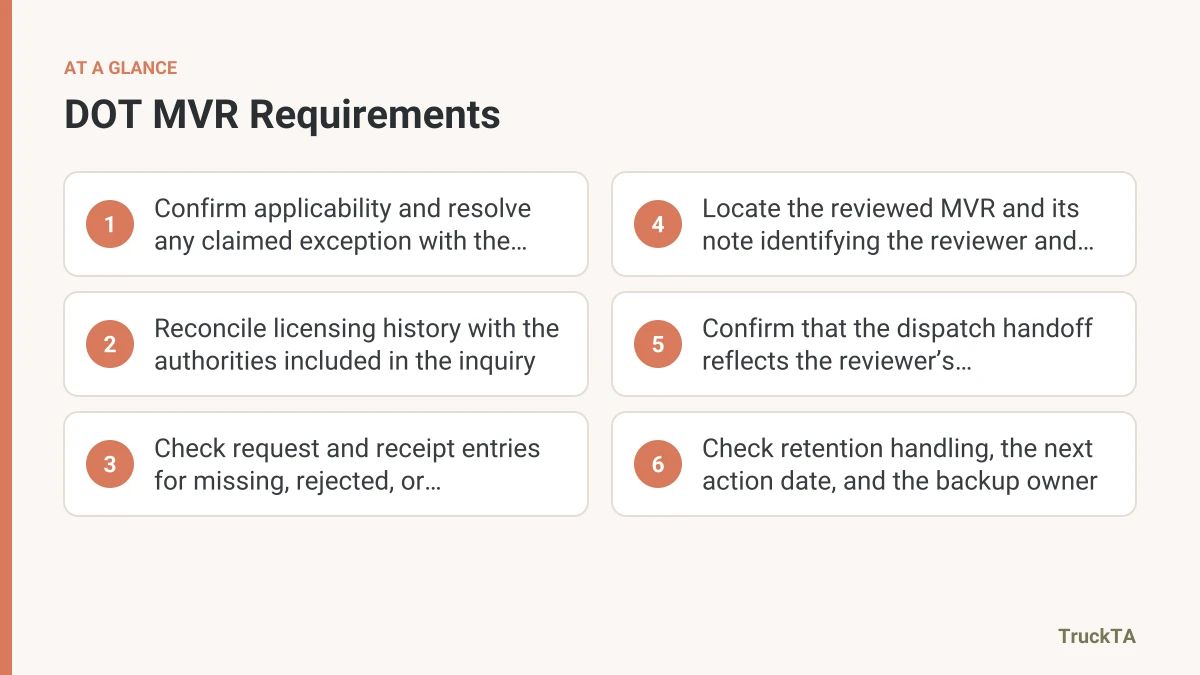
Confirm applicability and assign responsibility
Start with your employed-driver roster and identify who owns each recurring review. Record the driver identifier, licensing information, request owner, and designated reviewer. In a small fleet, the same person can manage both tasks as an internal staffing arrangement.
However, confirm applicability before deciding which drivers belong in the process. Section 391.25 makes its annual inquiry and review requirements subject to subpart G exceptions (opens in a new tab). Have a qualified compliance reviewer resolve any claimed exception before you remove a driver from tracking.
For example, dispatch might be moving a driver onto a gooseneck while the office checks the employment file. Record the proposed work for the reviewer. Don’t use the equipment label as your answer to an applicability question.
Also, keep hiring work outside this recurring task. For that separate stage, see FMCSA Background-Check Requirements: A Carrier Hiring Workflow. Confirm initial-screening requirements independently rather than copying the annual calendar into an onboarding task.
Track the inquiry and review separately
For drivers subject to § 391.25, the carrier must make the inquiry at least once every 12 months (opens in a new tab). The carrier must also review the driving record at least once every 12 months (opens in a new tab). Give each action its own date field.
Then set an internal start date that leaves room for rejected requests, missing returns, and reviewer availability. That lead time is your operating buffer, not another federal interval. Choose it around the actual ordering process and your office coverage.
Keep a named backup beside the primary owner. If the coordinator is away when a return arrives, someone else should know where it belongs. Otherwise, the attachment can sit in an inbox while the calendar still shows only “requested.”
Request Records From the Right Licensing Authorities
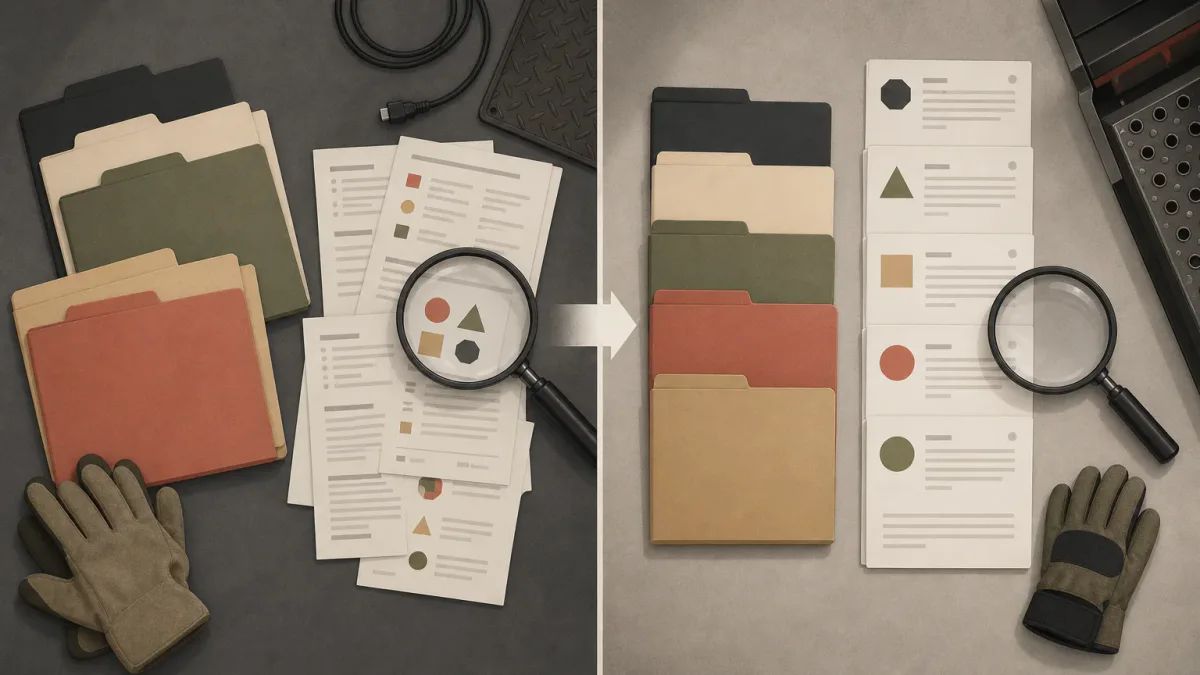
Reconcile licensing history before ordering
Under § 391.25, the annual inquiry must obtain a record covering at least the preceding 12 months (opens in a new tab). It goes to each licensing authority where the driver held a commercial motor vehicle operator’s license or permit during that period (opens in a new tab), subject to subpart G exceptions.
Accordingly, ask your driver about licensing changes before building the request list. Compare the answer with the information already in the file. The easiest license image to find shouldn’t become the request list by default.
Suppose a driver reports a licensing change during the review period. Record the authorities involved, then reconcile them against the required inquiry scope. Keep a separate request entry for each authority involved so a missing return stays visible.
For your DOT MVR Requirements workflow, make the request log specific: driver identifier, authority, request date, response status, and follow-up owner. Avoid a single “MVR done” field that hides whether the office ordered, received, or reviewed anything.
Check the return before sending it to review
FMCSA’s New Entrant guidance identifies the state motor vehicle department that issued the license as a source for driver records (opens in a new tab). Confirm the authority’s current ordering procedure, identity requirements, and any required authorization before submitting your request.
Once the record arrives, check driver identity, issuing authority, legibility, and page completeness. Also, compare the returned material with the period requested. Treat those checks as intake work, separate from assessing the driver’s history.
If a request comes back rejected, preserve the response and assign the correction. For example, reconcile a mismatched identifier before submitting again. Keep the original request and the follow-up connected so your backup coordinator can see what changed.
Next, send the checked return to the named reviewer with its request reference. Use a clear handoff such as “record received; review pending” in your internal log. That tells the office what happened without implying a qualification determination.
Assess the Driving History and Resolve Questions
Apply the required review criteria
Under § 391.25, the review determines whether the driver meets minimum requirements for safe driving or is disqualified under § 391.15 (opens in a new tab). Your reviewer needs to assess the driving history, not simply confirm that the file contains an MVR.
The carrier must consider any evidence of violations of applicable Federal Motor Carrier Safety Regulations or Hazardous Materials Regulations (opens in a new tab). Accordingly, give the reviewer a way to gather relevant evidence beyond the returned attachment and identify questions requiring clarification.
The carrier must also consider the driver’s accident record and evidence of violations of laws governing motor-vehicle operation (opens in a new tab). Keep relevant supporting material connected to the review rather than scattered across incident emails and individual staff folders.
Additionally, the rule requires giving great weight to violations indicating disregard for public safety, such as speeding, reckless driving, and operating under the influence of alcohol or drugs (opens in a new tab). Do not replace that assessment with an unsupported pass-or-fail shortcut.
Clarify entries before recording a determination
Suppose the return contains an unfamiliar event code. Instead of guessing, record the exact question and contact the issuing authority for clarification. Preserve the explanation with your working material so the reviewer can see what informed the assessment.
DOT MVR Requirements need a documented assessment, not an invented universal violation count. Have your qualified reviewer verify current applicable disqualification provisions when necessary. Keep additional company screening criteria distinguishable from the regulatory determination.
Meanwhile, give dispatch a named contact and an expected update time. The dispatcher should be able to plan around the pending decision without interpreting an unfamiliar code while chasing a missing gate release for a brokered load.
For related staff preparation, see DOT Compliance Training for Car-Hauling Fleets: A Role-Based Plan. Practice the handoff with a sample pending review. Ask your dispatcher to identify the decision owner and next action without opening the underlying driving record.
File the Review Note and Preserve the Record
Connect the note to the MVR reviewed
Section 391.25 requires a copy of the MVR in the driver’s qualification file (opens in a new tab). It also requires a review note containing the reviewer’s name and the review date in that file (opens in a new tab). Keep those required elements easy to locate.
For a useful working record, also identify the MVR examined and record the determination. You can include supporting references and follow-up actions. These additions are recommended operating practices, not an expanded statement of the rule’s required note contents.
Then save the record and note under the same driver identifier and review cycle. Distinguish the issuing authority’s return from your working notes. Someone opening the review note should be able to locate the matching MVR without searching email.
For related forms, see Free Driver Qualification File Forms: Downloads and Setup. Whatever format you choose, check the completed note rather than just the template. An empty reviewer field is still an unfinished documentation task.
Set retention handling before replacing attachments
Under FMCSA’s New Entrant MVR guidance, carriers must keep the MVR for 3 years (opens in a new tab). Before deleting records, verify current retention requirements, applicable exceptions, and the treatment of each document with your qualified compliance reviewer.
For broader retention handling, consult FMCSA’s Motor Carrier Safety Planner guidance on qualification files and § 391.51 document retention requirements (opens in a new tab). Confirm review-note retention separately before approving a deletion schedule; don’t assume every file item follows an identical rule.
In practice, organize DOT MVR Requirements evidence by driver and review cycle, not a replaceable attachment named “current MVR.” Use the authority and relevant date in the filename. Preserve older material until its applicable retention treatment has been confirmed.
Also, separate the dispatch handoff from detailed record storage. As an internal handling practice, send the reviewer’s determination and necessary follow-up information rather than posting the full MVR in a load conversation. Give detailed access to staff who need it.
Test Completion on an Actual Driver Packet
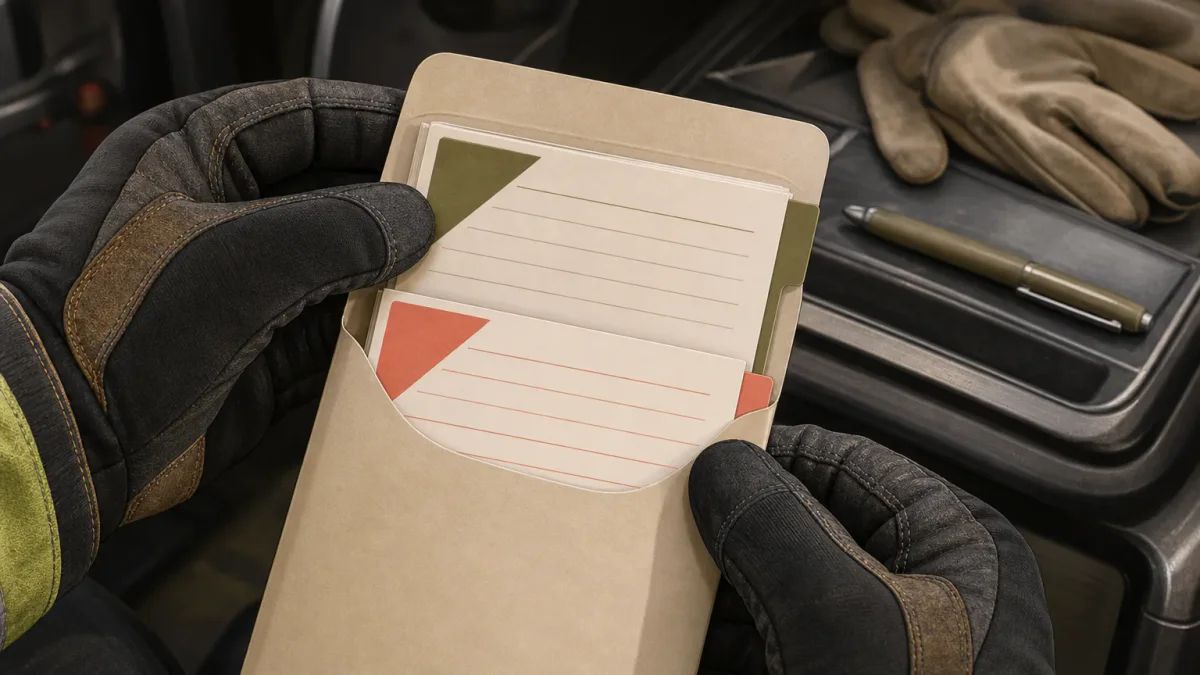
Run the packet-level completion check
Choose a driver whose annual review is approaching and work through the actual file. Rather than testing an empty template, follow the licensing history, request entries, returned records, and reviewer assignment. Give every gap a named owner.
Checklist
0 of 6 done
Next, ask your backup coordinator to retrieve the packet without help from its usual owner. Check that the MVR opens, all pages are readable, and the note matches the record. This is a retrieval test, not a second qualification assessment.
Repair the failed handoff
If the record arrived but nobody reviewed it, fix the receipt-to-review handoff. Assign the reviewer and make the pending task visible. However, if the review occurred and the note is missing, address the documentation gap instead of ordering another record automatically.
For each correction, identify what will prevent the same miss next cycle. Perhaps the return reached an unattended inbox, or the backup owner lacked access. Change that specific step rather than adding another general reminder to the calendar.
Finally, test your DOT MVR Requirements workflow on the next pending packet before reorganizing historical folders. Carry the corrected handoff forward, and check that the new owner can complete it. Start with the part of the process that actually failed.
To explore driver record organization, try TruckTA for driver documents and qualification tracking. Start with your next MVR review packet: identify who collects the record, who reviews it, and where your team will keep the supporting evidence.
Frequently asked questions
What should we ask an outside MVR ordering provider?
Ask how it handles licensing-history changes, rejected requests, complete returns, and record retrieval. Confirm the proposed arrangement with your compliance reviewer before relying on it.
What if a driver disputes an entry on the record?
Document the specific dispute and ask the issuing authority about its correction procedure. Preserve the original return separately from any corrected version, and have your reviewer assess the unresolved issue.
How should an owner-operator establish the applicable process?
Ask FMCSA and a qualified compliance reviewer to assess your actual operating arrangement. Record their applicability determination before deciding who will request, review, and retain the records.
Put it into practice
Keep your operation moving with TruckTA.
Bring loads, drivers, documents, payments, and settlements into one connected workspace.