DOT Compliance Training for Car-Hauling Fleets: A Role-Based Plan
Build a role-specific training plan for drivers, dispatchers, supervisors, and records staff. Set practical assessments, document results, and assign refresher triggers.
By TruckTA Editorial Team · TruckTA Resources

In this article
Your driver finishes orientation, but the next dispatcher still doesn’t know who can clear an equipment hold. The records coordinator collects a certificate without checking what it covers. Then a supervisor changes roles, and nobody updates the training assignment. Build your program around those handoffs, not just course completion.
For a multi-driver operation, DOT compliance training should connect each person’s responsibilities to instruction, a practical assessment, and retrievable evidence. Start with a role matrix. Give every module an owner, define what successful performance looks like, and decide what triggers another assessment.
1. Decide which requirements and procedures to teach
Write a short operating profile before buying training. Include your operating entity, routes, jurisdictions, cargo, truck and trailer configurations, driver licensing status, and staff responsibilities. Describe the pickup-and-gooseneck operation separately from the tractor and multicar carrier. Give the reviewer actual ratings and operating details rather than the label “small fleet.”
Separate the proposed curriculum into legal requirements awaiting confirmation, equipment-specific instruction, and company procedures. Keep those labels visible. A dispatch communication exercise belongs in your program, but don’t present its duration or refresher schedule as a federal mandate.
This is a company training workflow, not a determination of your legal obligations. Before adopting it, have a qualified transportation compliance reviewer verify current federal and applicable jurisdiction requirements. Ask for written conclusions, supporting provisions, effective dates, and affected roles. Leave unresolved questions open rather than marking them “not applicable.”
Give the reviewer specific questions
The supplied GovInfo PDF is from the October 1, 2020 CFR edition. Use that historical text to identify review topics, not to establish current requirements. (govinfo.gov (opens in a new tab))
| Review question | Supplied official source | Decision to document |
|---|---|---|
| Which supervisors need reasonable-suspicion training? | Section 382.603 addresses supervisor training for reasonable-suspicion determinations on PDF page 2, printed page 225, of the supplied 2020 excerpt. (govinfo.gov (opens in a new tab)) | Current applicability, covered people, content, duration, and evidence. |
| Which drug-and-alcohol materials and receipt records apply? | The supplied 2020 text of § 382.601 addresses educational materials in paragraph (a) and signed certificates of receipt in paragraph (d). (govinfo.gov (opens in a new tab)) | Current materials, recipients, delivery timing, and acknowledgment procedures. |
| Does the driver’s licensing situation require ELDT? | FMCSA’s Entry-Level Driver Training overview identifies covered licensing situations and exceptions. (fmcsa.dot.gov (opens in a new tab)) | Driver-specific applicability, completion evidence, and separation from company orientation. |
| Which HOS procedures should dispatch exercises test? | FMCSA’s Hours of Service overview identifies 49 CFR Part 395 as the HOS regulatory framework. (fmcsa.dot.gov (opens in a new tab)) | Applicable limits, exceptions, and approved planning procedures. |
| Which ELD tasks should drivers practice? | FMCSA’s ELD Carrier-Driver Training includes instruction on transferring ELD records to safety officials. (fmcsa.dot.gov (opens in a new tab)) | Device-specific practice, approved exception procedures, and assessment criteria. |
For each operating jurisdiction, ask the reviewer to identify the responsible agency and attach the relevant official source. Don’t copy another fleet’s state-specific conclusions. Reopen the review when your equipment, cargo, operating territory, or staffing responsibilities change.
2. Assign training around the decisions each role makes
Create one row for each person and assigned module. Include primary and backup duties, module version, trainer, assessment method, result, and next review trigger. Where one employee handles dispatch and records, assign both sets of exercises. Don’t let the job title hide the work.
| Role | Company training focus | Evidence to collect |
|---|---|---|
| Drivers and loaders | Equipment-specific procedures, approved securement methods, ELD tasks where assigned, defect reporting, and escalation. | Observed demonstration with equipment identified and unresolved tasks recorded. |
| Dispatchers | Assignment feasibility, delay response, driver and equipment holds, and shift handoffs. | Completed scenario showing decisions, communications, and escalation. |
| Driver supervisors | Coaching, task restrictions, incident escalation, and separately reviewed supervisor training obligations. | Relevant course evidence plus an assessed company-procedure exercise. |
| Records and hiring staff | Document identification, review routing, access controls, missing evidence, and status handoffs. | Sample packet correctly organized and routed without premature approval. |
| Maintenance coordinators | Defect intake, unit identification, repair evidence, and release communication. | A simulated defect traced through the approved process. |
| Fleet owner or program manager | Applicability decisions, reviewer selection, unresolved gaps, and corrective-action follow-up. | A documented program review with owners and completion dates. |
Choose evaluators deliberately. Ask whether the person understands the equipment, the approved procedure, and the limits of their assignment. Have the regulatory reviewer identify any required evaluator qualifications. Don’t appoint someone solely because they have the longest tenure.
Give backup staff the same task-specific assessment before assigning independent responsibility under your company program. A weekend dispatcher should practice the equipment-hold handoff, even if the weekday team usually handles it. An owner covering dispatch should complete that exercise too.
For new drivers, connect this matrix to the first-week training plan. Keep the matrix focused on fleet-wide responsibilities and continuing assessment rather than duplicating that onboarding sequence.
3. Test performance with realistic car-hauling exercises
Write the assessment before delivering the lesson. Decide what the trainee must demonstrate, what evidence the evaluator will record, and which mistakes prevent completion. Use the approved procedure as the answer key. Avoid improvised pass criteria that change with the trainer.
Combine explanation with practice. Ask the trainee to explain the decision, perform the task in a controlled setting, and complete the handoff record. Keep unsafe conditions simulated. Do not create a live equipment defect or interfere with an active trip to test a response.
Test a delay across both sides of dispatch
Use an illustrative brokered load with pickup deadhead, loading time, a gate release, and a delivery appointment. Provide a fictional driver availability record consistent with the reviewer-approved HOS lesson. Midway through the exercise, introduce a pickup delay. Ask the driver what information to report and ask dispatch to reassess the assignment.
Score the reasoning, not just the revised ETA. Did dispatch account for the remaining work? Did the driver communicate the changed circumstances? Did the team follow the approved escalation process? Have them document the next action and the person responsible for notifying the customer.
Run ELD practice using the fleet’s device instructions and an appropriate training environment. Include retrieving information, identifying the assigned driver, and following the approved exception procedure. Do not change live records merely to produce a training example.
Test equipment and record handoffs
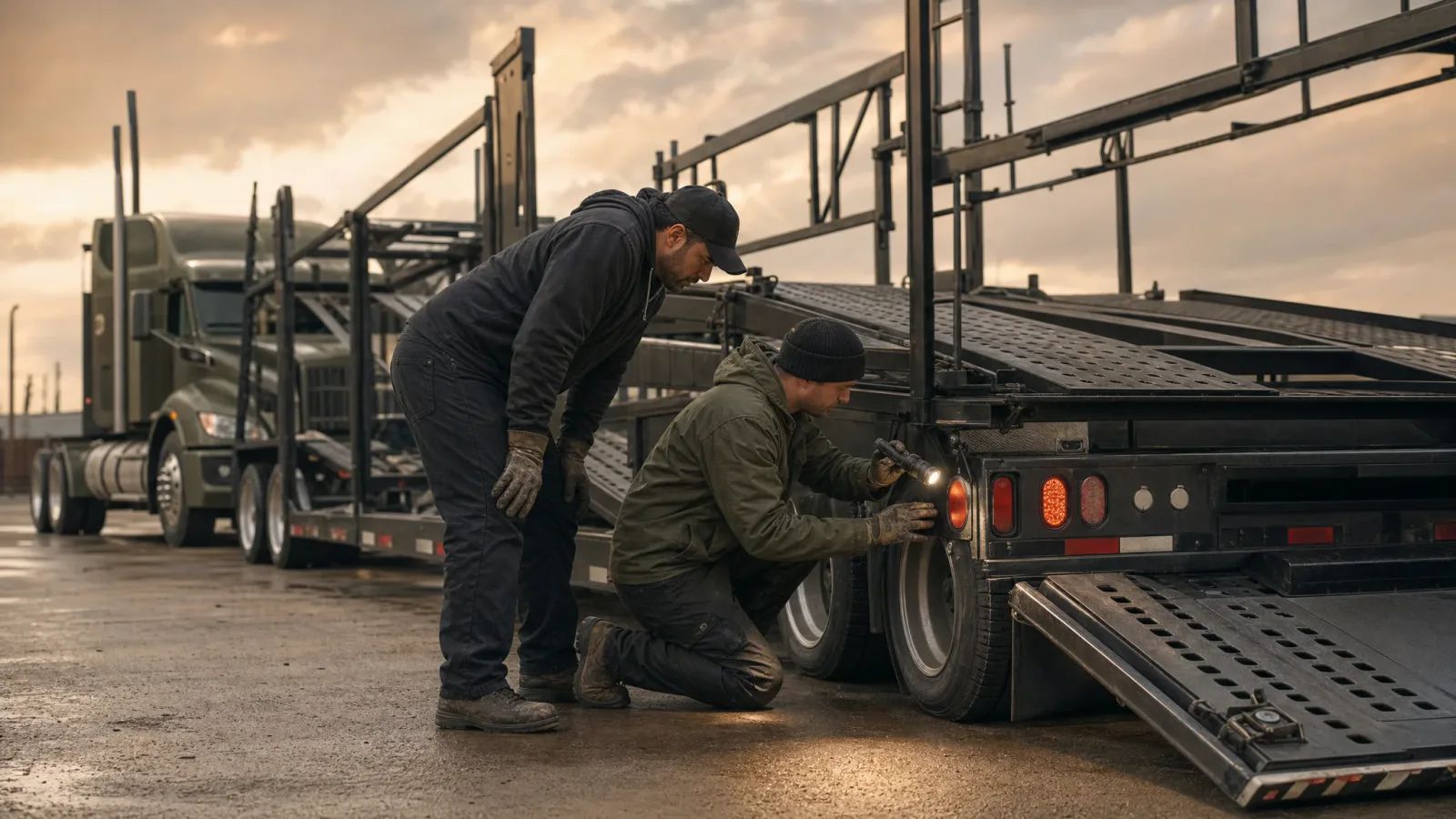
For a parked-trailer exercise, ask the driver to demonstrate the approved inspection and securement procedure for that equipment. Use photographs to introduce an exception. Have the trainee identify the concern, explain the reporting path, and show where the affected task would remain on hold under company procedure.
Give maintenance and dispatch the same fictional case. Include a repair appointment but no completed repair evidence. Evaluate whether staff distinguish scheduling work from documenting its completion. Use a different truck or trailer number in one attachment to test whether anyone notices the mismatch.
Give records staff a sample packet containing a course certificate, a policy acknowledgment, a condition report, and an incomplete assessment. Ask them to classify each item and identify the open work. For this program, record attendance, acknowledgment, demonstrated performance, and task authorization separately.
Record a failed exercise precisely. Write “did not identify the trailer-number mismatch,” not “needs more training.” Assign coaching to that gap and reassess it. Preserve the original result alongside the later outcome rather than replacing the failed attempt.
4. Keep evidence that explains the training decision
Build a training record someone else can understand without calling the instructor. Use a consistent employee or contractor identifier, module name, revision, delivery date, instructor, assessment method, outcome, and evidence location. Record equipment identifiers when the demonstration is equipment-specific.
Keep the lesson or course outline with the record reference. If a provider issues a certificate, capture what the course covered rather than relying on its title. Send claims about regulatory coverage to the reviewer, especially when the course was selected for a particular legal obligation.
Use explicit company statuses: assigned, instruction completed, assessment pending, reassessment needed, or assessed for the named task. Avoid a single green “compliant” flag. In this workflow, task assessment does not close separate driver-file, licensing, medical, equipment, or other readiness reviews.
Give dispatch the assignment-relevant outcome and escalation contact. As an access-control practice, keep sensitive personnel information out of general dispatch notes. Ask the reviewer to approve access and retention schedules by record category; don’t invent one retention period for every document in the training folder.
Connect open training actions to the broader DOT compliance checklist. Keep detailed assessment evidence in the training record rather than duplicating it across several lists.
Test retrieval during an internal review. Select one driver, one dispatcher, and one supervisor. Ask the records owner to produce their assigned modules, completed evidence, outstanding actions, and current procedure versions. Treat missing evidence as an open issue until the responsible reviewer resolves it.
5. Set refresher triggers and approve the pilot
Build two separate schedules: legal obligations confirmed by your reviewer and company-selected refresher practices. Label them clearly. For internal planning, you might review open training actions monthly and run a short scenario each quarter. Those are suggested management intervals, not statements of federal training frequency.
Add event-based reviews for a new trailer configuration, changed responsibilities, revised procedure, failed assessment, or recurring operational mistake. Before assigning new equipment-specific work, have the program owner decide what additional instruction and assessment the person needs under the approved company program.
After a roadside finding, near miss, or repeated defect-reporting problem, examine the process before assigning another course. Ask whether staff lacked knowledge, used an outdated procedure, received conflicting instructions, or couldn’t reach the designated decision-maker. Match the corrective action to the gap. When several people miss the same step, review the instruction and handoff too.
Launch with one controlled pilot
Start with one driver-dispatcher pair and a records owner. Pilot the delay exercise and one equipment handoff. Note unclear instructions, missing evidence fields, and decisions that depend on an unavailable manager. Revise the module before assigning it across the fleet.
Before expanding the pilot, close these decisions. Put an individual’s name beside each owner role in your working copy.
Checklist
0 of 4 done
Explore TruckTA compliance records with a concrete retrieval exercise. Use Documents, company checks, and inspection records as the starting areas, then ask your records owner to locate one relevant item from each. Record gaps in ownership or retrieval. Keep training assessments and regulatory decisions in your designated records process; don’t assume these product areas deliver courses or approve compliance.
Related TruckTA resources
Editorial references
Sources checked
Requirements can change and may depend on jurisdiction, vehicle, weight, operation, and driver status. Confirm current applicability with the responsible agency or a qualified adviser.
- Eld carrier driver trainingfmcsa.dot.gov · checked October 30, 2026
- Entry level driver training eldtfmcsa.dot.gov · checked October 30, 2026
- Hours of servicefmcsa.dot.gov · checked October 30, 2026
- CFR 2020 title49 vol5 sec382 601govinfo.gov · checked October 30, 2026
Put it into practice
Keep your operation moving with TruckTA.
Bring loads, drivers, documents, payments, and settlements into one connected workspace.