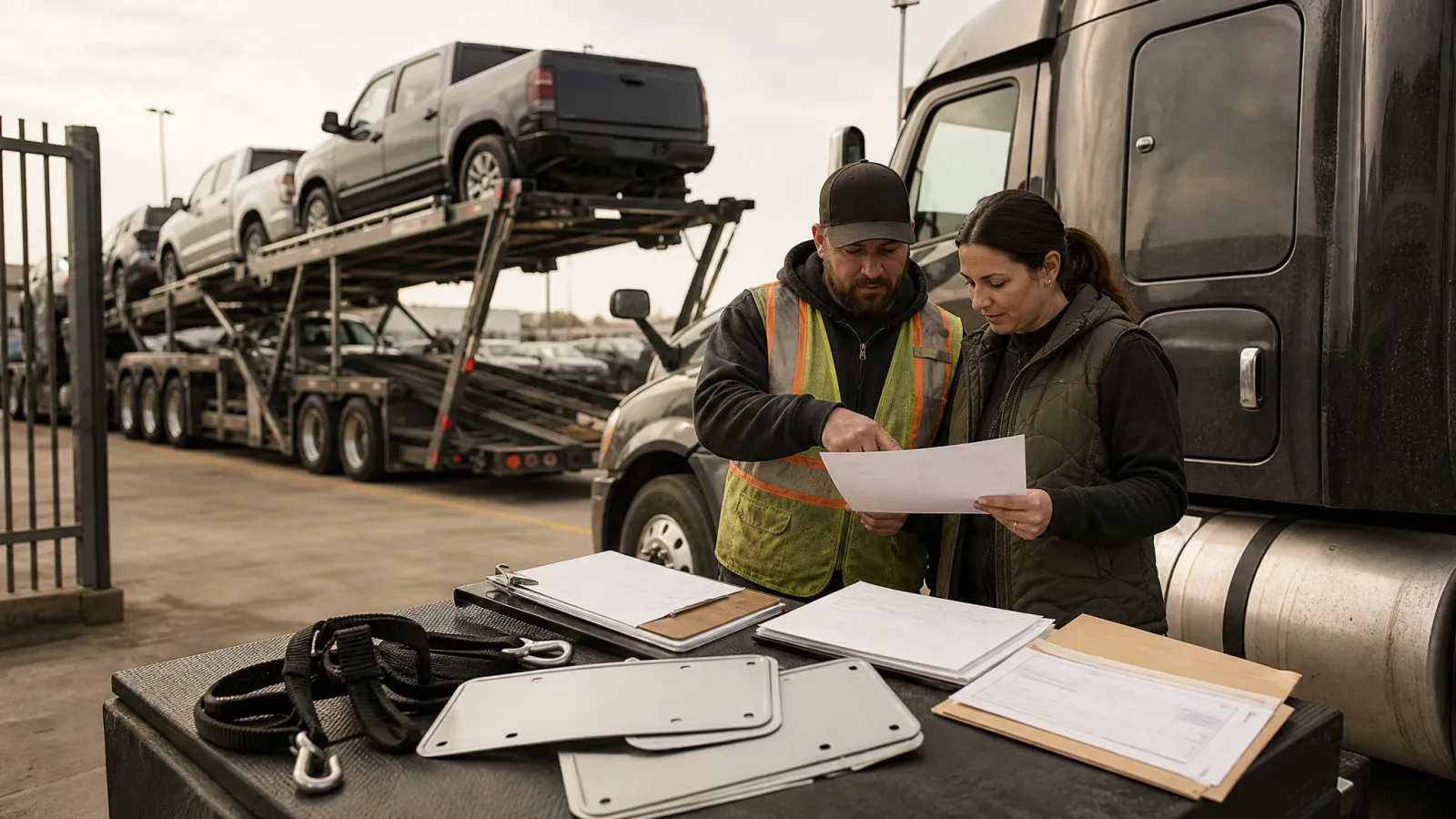
Car Hauler Driver Status Update Checklist: What to Report at Every Milestone
Standardize driver updates for arrival, condition exceptions, loading, delays, revised ETAs, delivery, and missing paperwork on every vehicle-transport load.
By TruckTA Editorial Team · TruckTA Resources

In this article
- 1. Car hauler driver status update checklist: the minimum useful update
- 2. 1. Arrival update: establish the clock
- 3. 2. Vehicle condition exceptions: stop the ambiguity
- 4. 3. Loading complete: confirm what actually left the yard
- 5. 4. Appointment risk: raise it before the missed window
- 6. 5. Delay notification: report the cause, not just the symptom
- 7. 6. Revised ETA: make the number defensible
- 8. 7. Delivery completion: close the load before leaving the conversation
- 9. A copy-and-send status template
- 10. Make the checklist the dispatch standard
- 11. Frequently asked questions
- 12. Related TruckTA resources
Dispatch doesn’t need a running commentary from the truck. It needs usable information at the moments when a load can change: the driver arrived, a vehicle has an exception, loading is complete, an appointment is at risk, a delay has a cause, the ETA moved, or delivery paperwork is missing. A short, standardized message keeps the dispatch board accurate and gives the office something to act on.
Use this car hauler driver status update checklist as the company standard for every assigned vehicle-transport load. The goal is simple: every update should tell dispatch what changed, what you need, and whether the appointment or next load is at risk.
Car hauler driver status update checklist: the minimum useful update
A good status update answers five questions in a consistent order: Which load is this? Where are you in the milestone? What changed? What action is needed? What is the risk to the current appointment or next dispatch? The message can be sent through your approved dispatch channel, but the format should stay recognizable whether the driver is using text, an app, or a phone call.
| Milestone | Driver should report | Dispatch should know |
|---|---|---|
| Arrival | Arrival time, exact facility or gate, check-in status, and any access problem | Whether the pickup or delivery clock has started and whether help is needed |
| Vehicle condition exception | Unit identifier, location of exception, photos or document status, and whether loading or delivery can continue | Whether to escalate before the vehicle changes hands |
| Loading complete | Completion time, units loaded, securement or paperwork status, and departure readiness | Whether the load is closed at pickup and whether the route plan changed |
| Appointment risk | Current location, cause of risk, available HOS or operating time, and realistic ETA | Whether to notify the facility, broker, customer, or next-load contact |
| Delay | Delay start time, specific cause, present location, expected duration, and revised ETA | Whether detention, rescheduling, routing, or load reassignment may be required |
| Delivery complete | Delivery time, receiving contact or location, vehicle condition result, and signed-document status | Whether the load can be closed and billing documents are complete |
| Missing paperwork | Exactly which document is missing, who has it, and the next recovery step | Whether the truck can depart or the file needs escalation |
1. Arrival update: establish the clock
Send the arrival message as soon as you reach the pickup or delivery location, not after you’ve already spent time looking for the gate. Include the facility name, arrival time, gate or check-in status, and any immediate access issue. If you’re waiting outside because the lot is full, the guard needs a contact, or the location on the dispatch sheet is wrong, say that plainly.
A practical format is: “Load 4821 — arrived 9:18 a.m. at North Lot gate. Checked in with security; waiting for release instructions. No vehicle exception observed. Pickup appointment still on track.” If you don’t know whether the appointment is still on track, report the facts and ask dispatch to confirm the next step.
The arrival message creates an operational timestamp. It shouldn’t be used to alter, replace, or describe the driver’s regulated record of duty status. Keep the dispatch update and the ELD record accurate as separate records.
2. Vehicle condition exceptions: stop the ambiguity
When a vehicle arrives with damage, a warning light, a missing key, a flat tire, personal property, or another condition that doesn’t match the dispatch information, identify the unit before describing the problem. Report where the exception is located, what you observed, whether photos were taken, and whether the facility is accepting or releasing the vehicle.
Don’t write “car damaged” when you can write “Unit 3, rear passenger door has a fresh-looking crease; photo set captured before loading; yard representative notified; waiting for instructions.” The second version gives dispatch a unit, a location, an evidence status, and a next action.
If the exception affects safe loading, securement, movement, or delivery acceptance, say so directly. Don’t make a damage determination that you can’t support, and don’t continue a disputed handoff without following the company’s escalation procedure.
3. Loading complete: confirm what actually left the yard
The loading-complete update closes the pickup phase. Report the time loading finished, the number of vehicles actually loaded, any units that were refused or left behind, and whether pickup paperwork is complete. If the load was changed, identify the exact unit removed or added and send the updated vehicle list through the approved process.
Also report whether you’re ready to depart. “Loaded” and “ready to roll” aren’t always the same. You may still be waiting on a gate release, a signed condition report, a key, a release number, or a correction to the bill of lading. If one missing item will hold the truck, name it and assign ownership: “Loading complete at 2:05 p.m.; four units aboard; signed BOL pending from shipping office; truck remains on site.”
4. Appointment risk: raise it before the missed window
An appointment-risk update belongs in the dispatch queue before the appointment is missed. Send it when the current facts show that the planned arrival is no longer reliable. Include your location, the cause, your available operating plan, the realistic ETA, and the next load or appointment that could be affected.
Avoid optimistic ETAs that depend on perfect traffic, no fuel stop, or no additional loading time. A useful message gives dispatch a planning number and a reason: “Delivery ETA moved from 3:30 to 4:15 p.m. after a two-hour pickup delay. Current location is 38 miles out. Next pickup at 6:00 p.m. is at risk unless it can be pushed.”
Dispatch can work with a risk notice. It can’t work with silence followed by “I’m late.” If the appointment is still achievable, say what supports that conclusion. If it’s not, ask for the specific action you need: reschedule request, customer notification, revised routing, or next-load review.
5. Delay notification: report the cause, not just the symptom
The car hauler delay notification checklist should capture the delay start time, current location, specific cause, expected duration, revised ETA, and operational impact. “Running behind” doesn’t tell dispatch whether the cause is a yard hold, breakdown, weather, traffic, shipper error, missing release, or a driver rest period.
If the cause is still developing, label it as unconfirmed. If the duration is unknown, provide the next review time: “Gate hold began at 10:40 a.m.; facility has not released Unit 7; next update at 11:15 a.m.; current delivery ETA unavailable.” That is more useful than inventing a number that will change again in ten minutes.
6. Revised ETA: make the number defensible
The driver ETA update checklist for auto transport should use the latest confirmed information, not the original route estimate. Report the destination, revised arrival time, distance or location context, and the event that caused the change. If the ETA depends on a facility response, identify that dependency.
When conditions change again, send a new update instead of allowing the old ETA to remain on the dispatch board. A revised ETA is useful only while it reflects the driver’s current plan. Dispatch should also know whether the next load is still workable after the change.
7. Delivery completion: close the load before leaving the conversation
A delivery-complete update should confirm the actual delivery time, receiving location or contact, vehicle condition result, and paperwork status. If there’s a delivery exception, identify the unit and describe the receiving party’s action: accepted with notation, refused, pending inspection, or awaiting a manager.
Send condition photos, signed delivery documents, and exception notes through the company’s approved workflow. The delivery message should tell dispatch whether the truck is released, still waiting, or blocked by a document or inspection issue.
Keep the supporting documents tied to the load file. The IRS says businesses may use an electronic recordkeeping system if it follows the same basic recordkeeping principles as paper records, and supporting documents should be kept in an orderly and safe manner. Confirm retention and tax requirements for your business with the appropriate adviser.
A copy-and-send status template
Use one short template so drivers don’t have to invent a message under pressure:
- Load or dispatch number.
- Milestone: arrival, condition exception, loaded, delay, appointment risk, delivery complete, or missing paperwork.
- Time and location.
- What changed.
- Action needed from dispatch or facility.
- Current or revised ETA.
- Current appointment risk: none, current appointment at risk, or next load at risk.
- Documents or photos: sent, pending, or unavailable.
For example: “Load 4821 — delay. Began 10:40 a.m. at West Yard, Bay 6. Release for Unit 7 is missing and yard office is checking records. Need dispatch to contact the pickup coordinator. Revised departure ETA is unknown; next update at 11:15 a.m. Delivery appointment is at risk. Photos and current paperwork sent.”
Make the checklist the dispatch standard
Put the required fields in the dispatch board, driver app, or company message template. Train dispatchers to acknowledge the update, record the decision, and tell the driver when another update is due. Train drivers to report exceptions early, use specific times and unit identifiers, and avoid mixing operational messages with ELD edits or certifications.
The standard should apply to every assigned vehicle-transport load, whether the move is routine or already showing risk. Adopt this car hauler driver status update checklist as the company standard, then review a sample of completed load files to see which fields are routinely missing.
Frequently asked questions
What should a car hauler driver report to dispatch?
The driver should report the load or dispatch number, milestone, time, location, what changed, action needed, current or revised ETA, appointment risk, and the status of photos or paperwork. The update should be specific enough for dispatch to make a decision without calling back for basic details.
When should a car hauler driver send a delay notification?
Send the notification as soon as the current facts show that the planned ETA or appointment is no longer reliable. Include the delay start time, specific cause, current location, expected duration or next review time, revised ETA if available, and whether another appointment or load is at risk.
Does a dispatch status update replace an ELD or hours-of-service record?
No. A dispatch update communicates operational facts such as a yard delay or revised ETA; it does not replace the driver’s required hours-of-service record or ELD actions. Follow the carrier’s ELD procedure and verify current FMCSA requirements before making compliance decisions.
What paperwork should be reported as missing at pickup or delivery?
Report the exact document that is missing, the facility or person expected to provide it, whether the truck can depart under company procedure, and the next recovery step. Examples may include a signed BOL, gate release, condition report, delivery receipt, or required exception notation.
Related TruckTA resources
- A Practical Car-Hauling Dispatch Workflow From Booking to Proof of Delivery
- Car Hauling Vehicle Condition Checklist: Pickup to Delivery SOP
- What Paperwork Should a Car Hauler Submit After Delivery? A Complete Closeout Workflow
Editorial references
Sources checked
Requirements can change and may depend on jurisdiction, vehicle, weight, operation, and driver status. Confirm current applicability with the responsible agency or a qualified adviser.
- Eld faq16 electronic logging devices and hours servicefmcsa.dot.gov · checked September 2, 2026
- Eld training checklist motor carriers understanding your devicefmcsa.dot.gov · checked September 2, 2026
- What kind of records should i keepirs.gov · checked September 2, 2026
Put it into practice
Keep your operation moving with TruckTA.
Bring loads, drivers, documents, payments, and settlements into one connected workspace.