Car Hauler Insurance Cost: Budget Before Adding a Truck
Compare current-fleet and expansion quotes, separate annual expense from payment dates, and test the added truck’s insurance budget against a slower dispatch month.
By TruckTA Editorial Team · TruckTA Resources
In this article
You’re ready to add another truck, but the insurance number in your expansion budget is still last year’s premium divided by your current fleet size. Before you commit to the equipment, replace that estimate with a quote for the operation you actually plan to run.
Build your car hauler insurance cost estimate around three numbers: the annual price for the proposed fleet, the additional cost compared with keeping your current operation, and the cash due on each payment date. Then test the added truck against a slower dispatch month, not just a full board. The dollar amounts below are illustrative calculations, not market rates or coverage recommendations.
Get two quotes that answer the expansion question
Request two proposals from your licensed insurance agent using the same effective date and comparable coverage assumptions: one for keeping the current fleet and one for the expanded operation. Specify the drivers, equipment, lanes, and cargo mix in each. Use the difference between those proposals in your expansion budget rather than treating last year’s bill as today’s baseline.
Keep the comparison clear. If the expansion proposal also changes coverage for existing trucks, have those changes identified beside the price. You’re trying to measure the cost of the proposed operation, not pretend that every dollar of the increase belongs to the new unit.
Request the annual premium by coverage, followed by the combined total. Put applicable taxes, policy fees, installment charges, and financing costs on separate lines. Mark each as included, additional, or not applicable. Don’t let a blank field become an assumed zero, and don’t add a fee twice because it appears in both the proposal and the payment schedule.
If the truck will enter service midway through the policy term, obtain the charge for the remaining term and a separate full-year planning estimate. Label the dates clearly. A six-month addition and a twelve-month proposal don’t belong in the same comparison column. Keep any annualized planning estimate labeled as an estimate, not a renewal commitment.
Keep the requirements review separate from this price exercise. This is a budgeting workflow, not a legal-minimum guide. Before binding coverage or changing operations, verify current requirements with the applicable federal and state agencies, and have your insurance professional review the proposed work and customer contracts.
Send one operating picture to every agent
Prepare one dated submission showing what you operate now and what you propose to add. Separate confirmed purchases and hires from possibilities. If you change trailers or revise the driver roster during quoting, send the same updated version to everyone. Include that version date in your comparison worksheet.
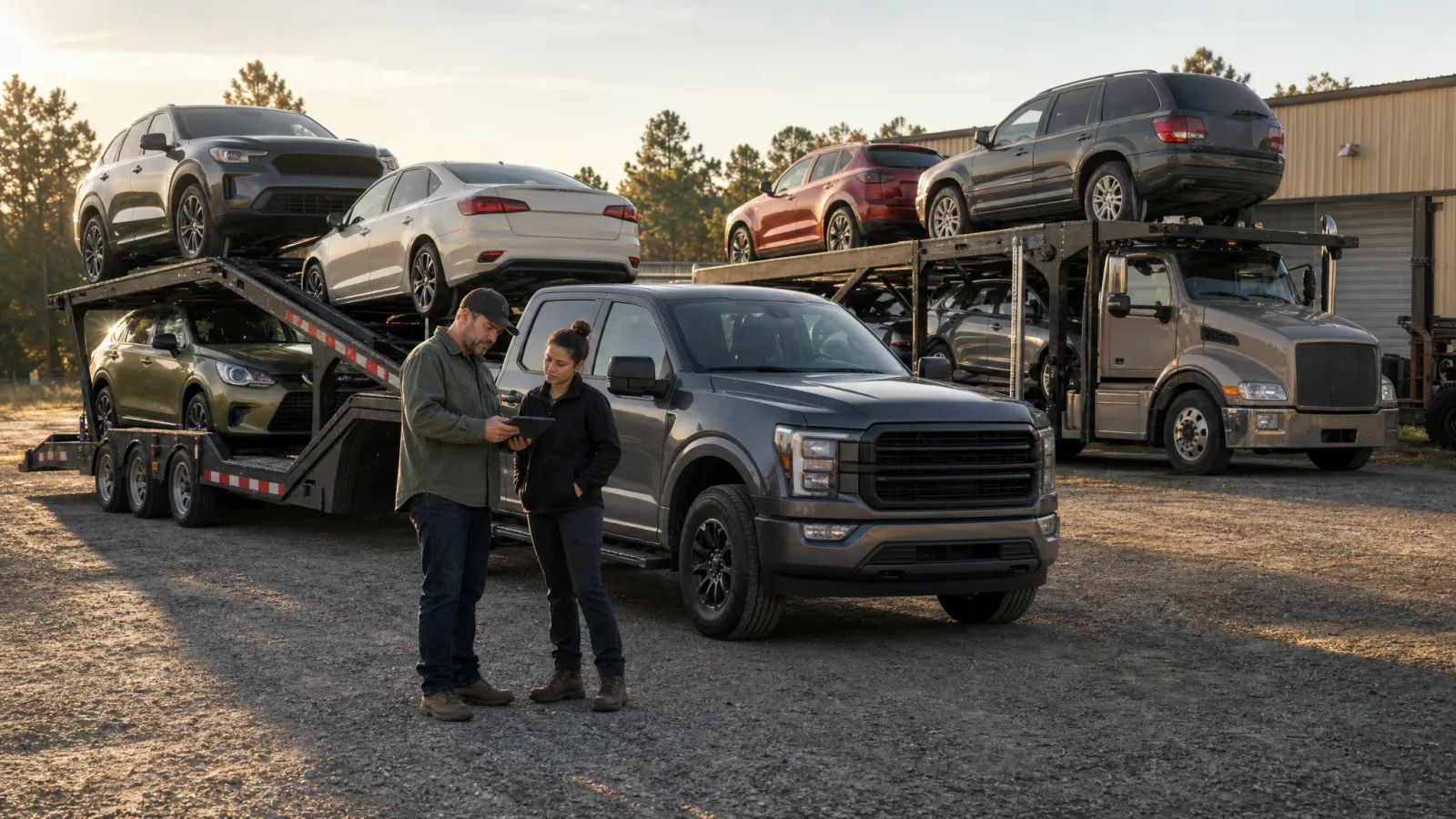
Describe the truck and trailer separately, including VINs where available, configuration, values, ownership or financing status, and intended use. For a pickup and three-car wedge, say exactly that. When pricing insurance for a three-car hauler, distinguish trailer capacity from fleet size: describe one truck-and-trailer combination carrying three vehicles, not simply “three vehicles.”
Show the cargo you expect to carry. Progressive’s motor truck cargo cost page identifies freight type and value as pricing factors. Use those points to prepare specific load examples, not to predict a premium from vehicle values alone. (progressivecommercial.com (opens in a new tab))
For illustration, three vehicles valued at $25,000 each total $75,000. Three valued at $80,000 each total $240,000. The trailer capacity hasn’t changed. Include both examples in the coverage review and request an explanation of applicable limits, valuation terms, exclusions, and deductibles. Neither total is a recommended policy limit.
Submit the actual driver roster rather than budgeting around assumed clean records. Progressive’s quote checklist says a price based on assumed clean driving histories may change after actual histories are reviewed. Send requested personal information through the agent’s secure submission method and distinguish confirmed drivers from positions you haven’t filled. (progressivecommercial.com (opens in a new tab))
Describe regular lanes, anticipated mileage, garaging locations, and planned changes in work. If the new truck will take longer brokered loads while the existing fleet stays regional, make that distinction visible. Present mileage as a planning assumption with a period attached, such as projected annual miles for the added truck, rather than an unlabeled fleet total.
Include the loss records requested for underwriting. Where an explanation is requested, keep it factual: what happened, what procedure changed, who owns it, and how completion is checked. If you’ve revised your condition-report process, describe the process you actually use. Leave any hoped-for discount out of the budget until it appears in the proposal.
Compare terms before choosing the lowest premium
Put proposals side by side using the worksheet below. Record the document version or page supporting each entry so you can trace a number without searching through an email chain. This is a purchasing worksheet, not a statement that every policy contains the same coverages or provisions.
| Comparison field | What to record | What to check |
|---|---|---|
| Quoted operation | Submission date, drivers, trucks, trailers, lanes, mileage, and cargo | Does it match the operation you intend to run? |
| Coverage and limits | Each quoted coverage, its limits, and omitted coverage | Which differences prevent a like-for-like comparison? |
| Cargo terms | Valuation terms, deductibles, exclusions, and endorsements | How are your typical and higher-value loads addressed? |
| Equipment terms | Truck and trailer values, valuation basis, and deductibles | Are both pieces of equipment described correctly? |
| Policy period and total | Effective dates, premium, and separately disclosed charges | Are the periods equal and charges counted once? |
| Payment schedule | Amount due at binding, installments, and due dates | What cash is needed before the truck earns revenue? |
| Outstanding conditions | Missing records, binding instructions, and person responsible | What must be resolved before coverage is confirmed? |
Bring operating situations to the coverage discussion: damage during loading, theft while parked overnight, a substitute driver, or borrowed equipment if you use it. Have the agent identify the relevant policy wording for each. Keep the written explanation with the proposal it addresses. A general assurance that you’re covered isn’t the explanation you’re asking for.
Give deductibles their own decision. Progressive explains that choosing a higher deductible can lower a commercial auto premium while increasing your out-of-pocket amount toward an applicable loss. Compare the actual quoted options instead of assuming the lowest premium is the best fit for your reserve. (progressivecommercial.com (opens in a new tab))
Suppose, purely for illustration, one option saves $2,400 annually but raises an applicable deductible from $2,500 to $10,000. That’s $7,500 more deductible exposure for $2,400 in annual savings. The arithmetic doesn’t predict claims or establish how the deductible applies. Use the proposal’s actual terms when deciding whether you’re comfortable funding that difference.
Before accepting a proposal, resolve its outstanding conditions and confirm the intended effective date. Make written confirmation of coverage and its effective date part of your internal release process for the added unit. Don’t use the equipment purchase date as dispatch authorization.
Separate expansion cost, truck allocation, and cash due
Use the additional annual cost to evaluate the purchase. Use an average or another documented allocation method to assign insurance overhead to trucks. Those calculations answer different questions, so give them separate lines in your worksheet.
Consider an illustrative annual comparison with matching coverage assumptions. Keeping three trucks costs $60,000; operating four costs $84,000. The average rises from $20,000 to $21,000 per truck, but expansion adds $24,000 to the annual budget. Put that $24,000 difference in the expansion business case, including any identified changes affecting existing units.
For an operating allocation, $84,000 divided by twelve months is $7,000 a month. Split evenly across four trucks, that’s $1,750 per truck per month. This equal split is a management choice for the example, not an insurer’s rating method. For a mixed fleet, use a unit-level breakdown where available and document how you assign shared costs.
Now test utilization for one allocated truck. Spreading its $1,750 monthly allocation across twenty revenue-producing days gives $87.50 per day. Across fourteen days, it becomes $125 per day. These are alternative views of the same monthly amount, not extra expenses to add together.
For that same truck, 8,000 total monthly miles produces an allocation of about $0.22 per mile; 5,000 total monthly miles produces $0.35 per mile. Both mileage figures belong to the individual truck receiving the $1,750 allocation, not the entire fleet. Include loaded miles and deadhead in that truck’s total.
Use the same mileage basis when evaluating a trip. If you assign insurance by total route miles, apply it to the pickup deadhead as well as the loaded leg. Don’t then add a second daily insurance charge to the same trip estimate. For organizing unit expenses, use the truck and trailer cost-tracking worksheet.
Build a separate cash schedule from the proposal’s actual payment terms. Enter the amount due at binding, every installment, and additional charges on their payment dates. The $7,000 monthly fleet allocation above is not a substitute for that schedule. For a midterm addition, obtain the billing arrangement before setting the equipment purchase date.
Keep a reserve scenario alongside the payment schedule. Test an applicable deductible payment, a period without revenue from the affected truck, and slower-than-planned collections. Use assumptions suited to your operation and review them with your insurance professional and financial adviser. Show money set aside for the reserve separately from premium payments; if you later model spending from that reserve, don’t also count the same amount as a second reserve contribution.
Finish the expansion calculation before folding it into a fleet average. In this example, the added annual expense is $24,000, while the equal monthly allocation is $1,750 per truck. Keep both labels visible so the next person opening the worksheet knows which number belongs in the purchase decision and which belongs in routine cost tracking.
Connect fleet changes to the next renewal
Assign one person to coordinate insurance changes and name a backup. Maintain a dated log of equipment purchases and sales, driver changes, garaging changes, and shifts in lanes or cargo mix. Obtain the agent’s instructions on which changes need notice and when, then build those instructions into your handoff process.
Set a renewal preparation date with the agent and work backward to collect the requested records. Compare the prior submission with what the fleet actually operated: which trucks stayed in service, who drove them, and what work they performed. Keep the supporting records together rather than rebuilding the operating picture from memory.
Keep condition reports, photos, and damage-escalation records organized as operating evidence, not as a promised route to a lower premium. Use the pickup-to-delivery condition-report workflow to standardize that part of the load file.
Explore carrier operations in TruckTA with a specific task: use its insurance information and renewal visibility to compare the information shown with your current policy records. Name the person responsible for correcting discrepancies and preparing the next renewal review. Leave coverage interpretation and binding confirmation with your licensed insurance professional.
Editorial references
Sources checked
Requirements can change and may depend on jurisdiction, vehicle, weight, operation, and driver status. Confirm current applicability with the responsible agency or a qualified adviser.
- Costprogressivecommercial.com · checked October 9, 2026
- Insurance discountsprogressivecommercial.com · checked October 9, 2026
- Quote checklistprogressivecommercial.com · checked October 9, 2026
- www.progressivecommercial.comwww.progressivecommercial.com · checked October 9, 2026
- www.progressivecommercial.comwww.progressivecommercial.com · checked October 9, 2026
- www.progressivecommercial.comwww.progressivecommercial.com · checked October 9, 2026
Put it into practice
Keep your operation moving with TruckTA.
Bring loads, drivers, documents, payments, and settlements into one connected workspace.